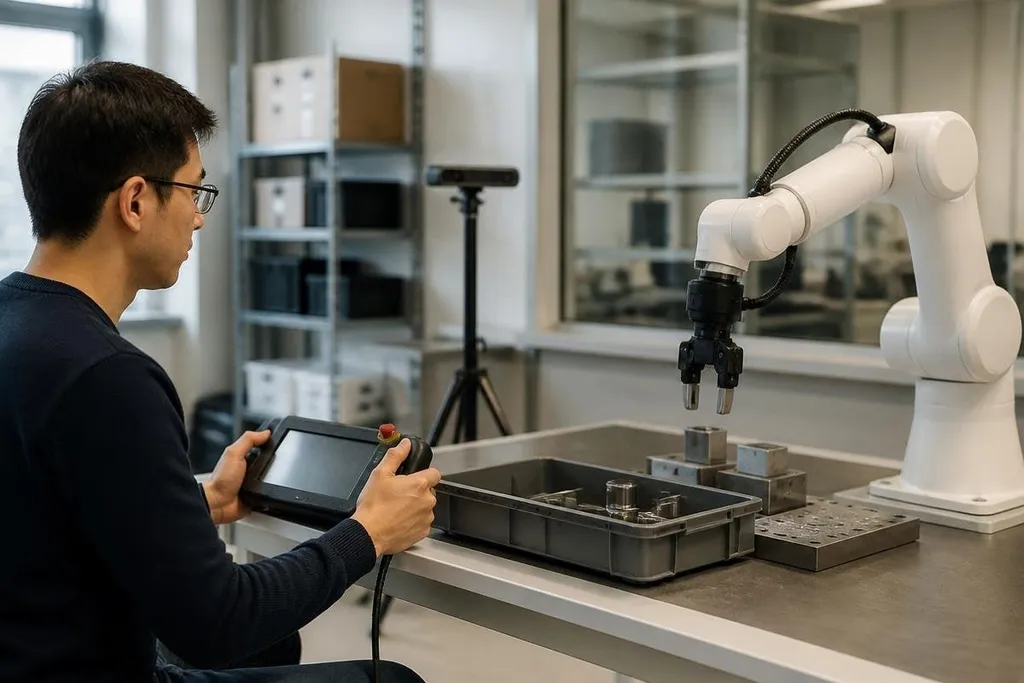
A robot can learn a task by watching a person move, rather than receiving a rule for every hand and arm position. That shift matters because many useful tasks contain small choices that are hard to write down.
- The method: a robot links what its sensors see to the actions a person took.
- The benefit: engineers can teach a task through examples, then test the robot on new cases.
- The limit: copied actions can fail when the robot sees something outside its training data.
How the robot learns
Imitation learning starts with demonstrations. A person may guide a robot through teleoperation, move its arm with a control device, or perform the task while cameras record the work area. The data can include images, joint positions, gripper commands, and contact signals from the robot’s sensors.
The system then learns a link between what it sees and what it should do next. In a common method called behavior cloning, the robot trains on pairs of observations and actions. Given a camera view, it predicts the movement that matched the person’s action in the training example.
That process can remove a large amount of hand-written code. An engineer doesn’t need to describe every small adjustment for placing an object. The robot can learn those adjustments from repeated examples, provided the examples cover the task well.
Why this matters for automation
Many factory and service tasks look simple until the object changes position, the lighting shifts, or the item bends in a different way. A fixed rule may handle one pose and fail on the next. Demonstrations give the robot examples of how a person responds to those changes.
The method also lets a skilled worker pass on practical movement. A person may slow down before contact, change grip force after feeling resistance, or move around an obstacle without stopping. Those details can be hard to express with a short list of rules.
For an engineer weighing this method, robotics research and testing can connect imitation learning with named robots and tasks. That context helps you judge whether a recorded motion is ready for the next training run.
The method can also shorten the path from a working idea to a test. An engineer can record examples, train a model, run it on the robot, and inspect the failures. The cycle still needs care, but the first version may come from data rather than a large software project.
Where copied behavior breaks
The robot only knows the situations represented in its training data. A small mistake can move it into a state the demonstrations never covered, and the next prediction may make that mistake worse. This problem is common when each action depends on the result of the previous one.
People also disagree about the right motion. One person may lift an object from the side, while another approaches from above. The training system must handle those different choices without losing the goal of the task.
Data quality matters as much as data volume. A demonstration with a blocked camera view, a late control signal, or an unsafe motion can teach the wrong response. Engineers need to check the recordings, repeat difficult cases, and test the robot away from the exact scenes used for training.
Safety adds another limit. A learned policy can suggest an action, but a separate control layer may still need to limit speed, force, joint range, and movement near people. I’d use imitation learning as a way to teach task behavior, with those safety limits kept outside the learned policy.
Imitation learning and other methods
Imitation learning works from examples supplied by a person.
Reinforcement learning uses a score or reward to push the robot toward better results, while traditional control uses a model of the robot and its environment. A working system may combine these methods rather than choose one for every task.
A learned policy can decide the broad action, such as reaching toward an object. A conventional controller can then turn that decision into safe motor commands. This division gives engineers a place to check force and position limits before the motors move.
The source of the examples also changes the result. Human demonstrations may be slow but careful. Robot-generated data can repeat a motion many times, though it may carry the limits of the setup that produced it. Video alone can show what happened, but it may not reveal contact force or the exact joint movement.
A practical decision guide
Use this check before choosing imitation learning for a robot task:
- Define the outcome: state what counts as success before recording examples.
- Record the hard cases: include changed object poses, blocked views, and failed attempts when safe.
- Measure the inputs: confirm that cameras, joint sensors, and grippers record the signals the model needs.
- Keep safety separate: set force, speed, and workspace limits in a control layer outside the learned behavior.
- Test new scenes: run the robot on positions and objects missing from the training recordings.
- Plan corrections: decide who will review failures and how new demonstrations will enter the next training run.
The next test for imitation learning is practical: can a robot keep its task behavior when the object, camera view, or contact force changes? Until that answer holds across the cases a site cares about, a demonstration teaches a starting point, not a finished system.